French Heritage Society
Preserving our historic treasures to inspire future generations
Château de Prye

The Château de Prye is distinguished by its majestic park and sumptuous stables featuring marble-paneled stalls.
Site History
The Château de Prye is an impressive residence dating back to the Middle Ages. In the 17th century, it was owned by the Queen of Poland. Situated within an extensive estate classified as a historic monument, the château is encompassed by seven kilometers of protective walls. The existing park, designed by Édouard André and Henri Duchêne, boasts a history of 150 years. Notably, the château’s stables feature unique marble paneling, making them one of a kind in France.
The stables of the Château de Prye were constructed in 1887 for Antonin du Bourg de Bozas, a former equerry of Napoleon III and a renowned supporter of the equestrian arts. The main stable building comprises three wings interconnected by a central pavilion, which has an imperial-style dome inspired by the baptismal gate of the Fontainebleau Castle. The layout of the structure revolves around a spacious hall, designed to accommodate horse-drawn carriages. The building includes a luxurious gallery adorned with nine marble-paneled stalls and an indoor riding arena.
About the Project
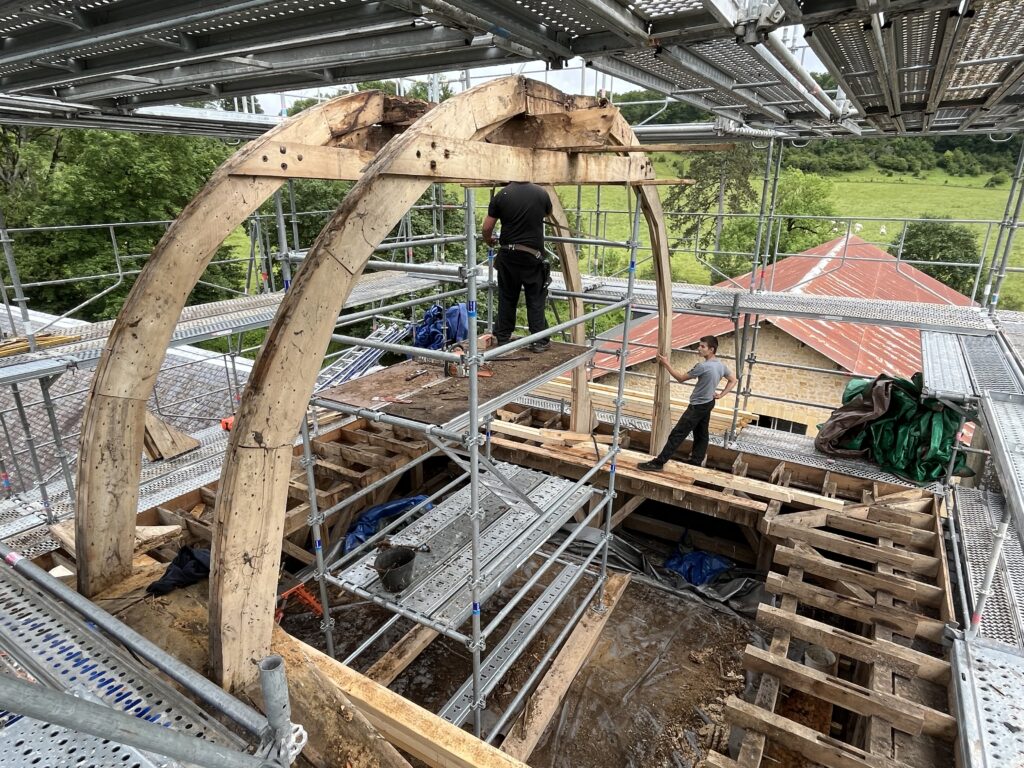
Since acquiring the property in 1990, the current owners have implemented several projects to enhance the value of the stables. The existing structures of the dome are concerning: the poplar planks have warped, posing a threat to the Philibert Delorme framework. The bell tower has sagged due to imbalance, and metal sheets have been installed as a temporary covering for the riding arena, replacing the slate roofing, in order to preserve the building. The annex no longer has a roof or framework; only the walls remain, and the joinery is practically nonexistent.
The restoration work aims to restore the stable building by addressing the roofing and framework of the central section, dome, riding arena and annex stables, including masonry repairs to the southern façade. It encompasses restoration of the large glass windows and the interior gallery of the stalls, as well as restoration of the annexes and the vaulted ceiling in the central hall.
Château de Prye Today
Once the stables are restored, owners Antoine-Emmanuel and Magdalena du Bourg de Bozas aim to further develop tourism and cultural activities centered around equestrian pursuits, particularly driving four-horse carriages. In addition to hosting horses and riders, they plan to organize equestrian competitions and other large-scale events to showcase their passion to a broader audience. Plans include renovating the first floor to expand accommodations and hosting a cultural program centred around living heritage, including equestrian arts, falconry, music, singing, artisan crafts, literature and more.
Project Initiated
Work Underway
Project Complete
Footer